Case studies
Real parts, real quantities and the decisions behind them. We keep our clients' names confidential, but everything else here is what happened.
Architecture and construction · Cape Town
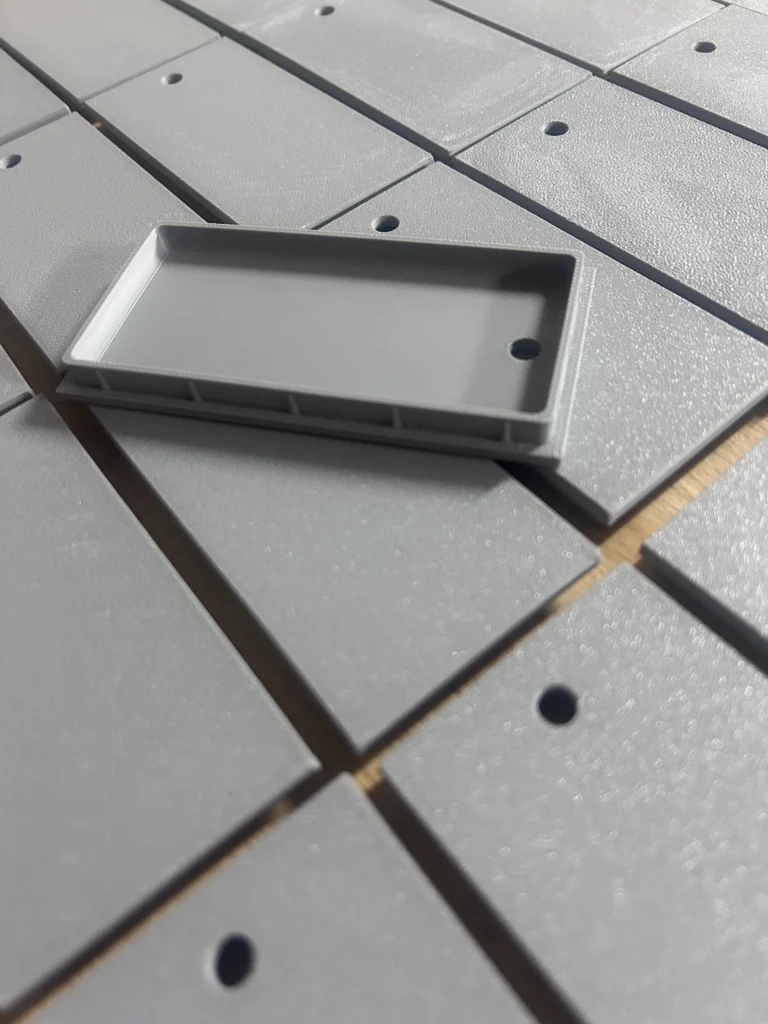
Every façade project used a different aluminium profile, and every profile needed its own end cap. A mould for each one didn't make sense. A flexible production method did.
Quantity
About 1,000 per run
Reorders
A few times a year
Material
ASA, custom grey
Service life
Outdoors, about 5 years
An aluminium fabricator needed end caps for extrusions used as architectural features on commercial buildings in Cape Town. The caps sit outdoors in full sun and Cape weather, with a service expectation of about five years. Each project uses a different extrusion, so each needs a different cap, at around 1,000 parts a time.
Once the sample was approved, the design went straight into a 1,000-unit run on six printers, about four to five production days of printing. When the next project uses a different extrusion, we adapt the CAD and run the new batch. No new tooling, and nothing to write off on the old design.
01
We modelled the cap to the customer's profile and printed about five prototype rounds to get the fit right before any production.
02
We printed samples with smooth and textured faces so the customer could compare real parts, not renders. They chose textured.
03
The final design has a drainage hole rather than a fully sealed cap.
04
We ruled out PETG for five years of full UV and printed in ASA, in a custom grey to match the façade.
Too many parts for prototyping, too few and too varied for an injection mould. That's the gap we work in.
Solar and renewable energy · Electronics
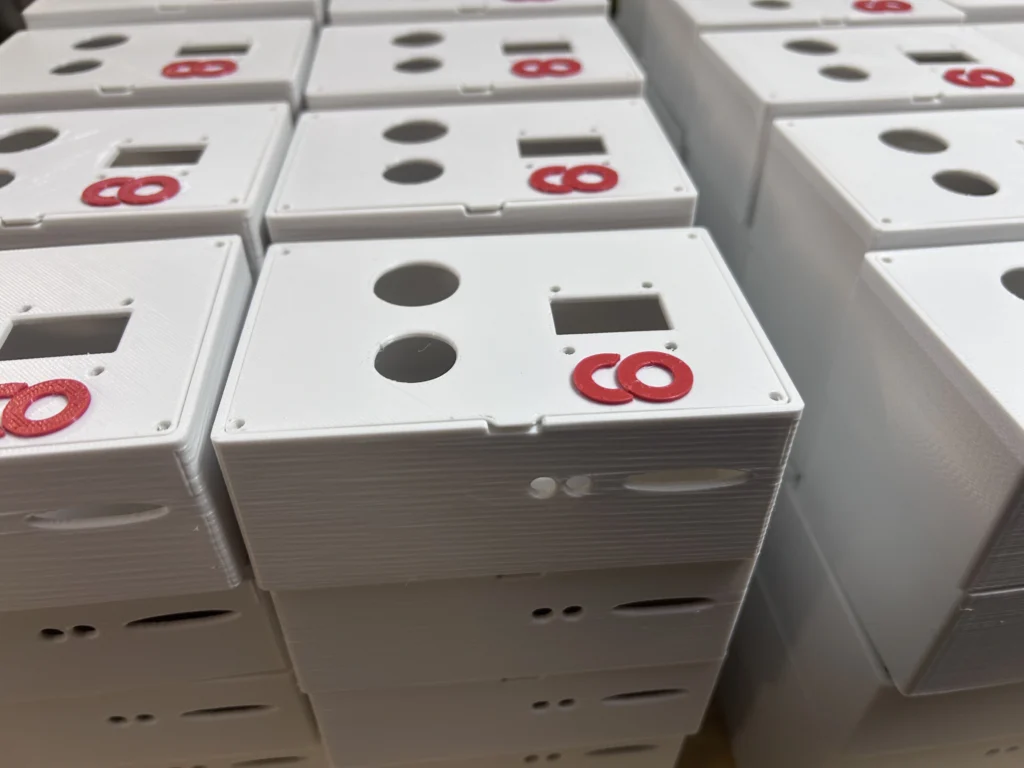
The client already had a design. It just wasn't drawn for 3D printing. We reworked it for production and delivered 250 finished enclosures in about three days.
Quantity
250 units
Turnaround
About 3 days
Material
PETG
Starting point
The client's own CAD
A solar company needed enclosures for the control electronics in its systems: a circuit board, an LCD screen and control buttons. They had their own CAD file, which saved development time, but it had been drawn without FDM production in mind.
250 enclosures in PETG, each with the client's logo printed into the lid, delivered in about three days. We supplied the screws with them, so the client could assemble straight away without sourcing hardware separately. They were particularly happy with the design improvements and the turnaround.
01
We worked from the client's existing file, so there was no starting from scratch.
02
We added 45° chamfers so the parts print without supports, reduced the wall thicknesses, and set the hole and lid tolerances so everything fits first time. That cut both print time and material on every enclosure.
03
The design houses the circuit board, with openings for the LCD screen and control buttons.
04
A filament colour change puts the client's logo straight into every lid, with no labels or separate printing step.
Already have a design? We'll make it print well in production, without losing what it needs to do.
Retail and food · Promotional
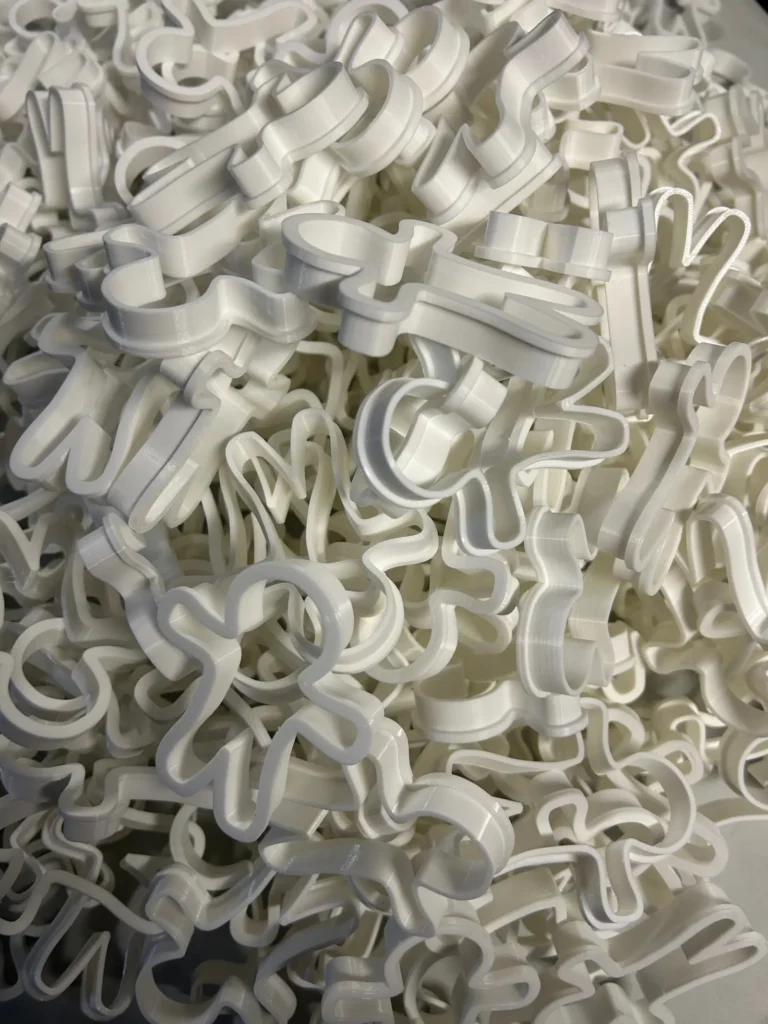
A major supermarket's Christmas promotion needed 6,100 custom gingerbread-man cookie cutters. The order arrived at the end of October.
Quantity
6,100 in one order
Deadline
Christmas promotion
Material
PETG
Print time
About 10 minutes each
A customer came to us at the end of October needing 6,100 custom gingerbread-man cookie cutters for a major supermarket's Christmas promotion. At that quantity, with a low target price per unit, every gram of plastic and every minute of print time mattered.
Once approved, the design went straight into production across our 12-printer fleet at about 10 minutes per cutter. All 6,100 were delivered in time for the Christmas campaign, with no mould to make and no wait for tooling.
01
We designed the cutter around the target unit price, using as little material and machine time as possible while still doing the job properly.
02
About four iterations to get a cutter that worked well and printed fast.
03
A thin edge cuts cleanly through the dough and keeps the part light and quick to print.
04
Around 1,000 machine-hours, spread across the fleet and scheduled to land before the deadline.
A big number on a tight deadline. With no mould to make, production starts as soon as the design is approved.
Send us the drawing, the quantity and how often you'll need it. We'll come back with a material recommendation, any design changes worth making and a price per unit.

