
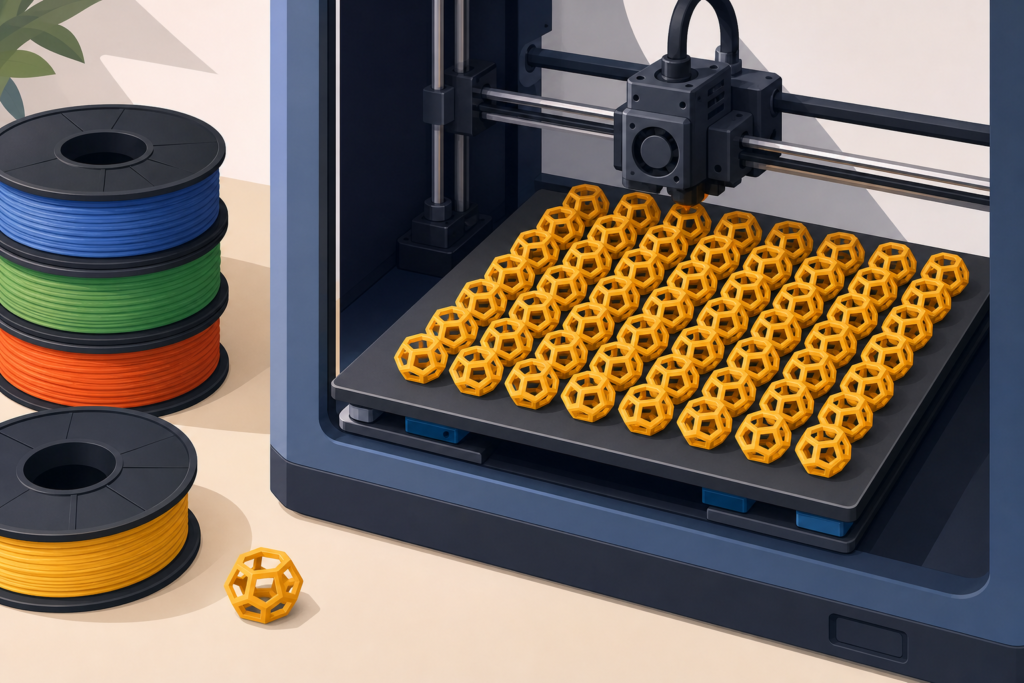
Not every 3D printing job is best handled as a one-off order. At 3D Riggers, we focus on bulk 3D printing because producing multiple copies of the same part allows us to work more efficiently, maintain consistent quality and offer more practical pricing. This approach suits businesses that already know what they need manufactured and can provide CAD, drawings, a sample or a clearly defined requirement.
Why bulk 3D printing suits repeat production
Our work is centred on repeatable industrial components rather than novelty items or single consumer prints. This includes electrical enclosures, plastic housings, end caps, brackets, device holders, jigs, fixtures, dummy components and other parts used in engineering, electronics, mining, manufacturing, automation, automotive and food production environments.
Bulk 3D printing is one form of additive manufacturing. It can be useful when a business needs a defined quantity of plastic parts without committing immediately to tooling or a larger traditional production setup. The right choice depends on the design, material, quantity, dimensions and intended use. Businesses comparing processes can first review what additive manufacturing means for South African businesses before deciding whether it fits their requirement.
The quantity does not need to mean thousands of parts. Low-volume manufacturing can be a practical middle ground when a business needs more than a prototype but is not yet ready for a high-volume tooling process. The important point is that the parts are defined, repeatable and required for a genuine business or production purpose.
Better filament pricing for larger orders
Buying and using filament for a larger production run makes the material cost more manageable. Bulk orders allow us to plan material usage more effectively and may make better filament pricing possible than would usually be practical for a single small print. The actual cost still depends on the part design, material, infill, supports, finish, quantity and production requirements, so a firm price needs enough information about the job.
Material cost is only one part of the total manufacturing cost. Preparation, machine time, support removal, basic cleanup, inspection, packing and any required design work can also affect the price. Producing a run of identical components helps these activities follow a repeatable process instead of being set up from scratch for every individual item.
More consistent quality control
When we print the same part repeatedly, the process can be refined around that specific design. We can identify the settings and production approach that work best, then apply them consistently across the order. This supports more uniform results from one part to the next and makes it easier to identify a part that does not meet the agreed requirement.
Consistency does not mean that every component is automatically suitable for every application. A part may require a particular material, orientation, wall thickness or post-processing approach. We select from materials such as PLA, ABS, PETG, ASA, TPU, polycarbonate, polypropylene, nylon and other listed options according to the practical requirements supplied. If the volume or application points to a different manufacturing method, we will say so rather than force the job into an unsuitable process.
A repeat production part should also have a clear definition of what matters. For example, the required fit, function, key dimensions, surface expectations and material behaviour may be more important than making every visible surface identical. Establishing these requirements before production helps avoid uncertainty and gives both sides a practical basis for reviewing the finished parts.
More efficient use of the print bed
Printing several copies of the same part allows us to arrange the print bed efficiently. Instead of leaving unused space around a single item, we can use more of the available build area for the same component. This improves production efficiency and can reduce the cost per part. The final arrangement depends on the geometry, support requirements and the largest build area available, which is 300 x 300 x 300 mm for the stated FDM build size.
The build area is not the same as the maximum practical size for every component. Part orientation, movement during printing, support structures and the required production finish can all affect how a design is arranged. A part that is too large for one build may need to be split, redesigned or considered for another production process. This is why reviewing the geometry before confirming a manufacturing route is important.
A better fit for repeatable production parts
- The same design can be prepared and tested for a repeat production run.
- Material usage can be planned more accurately.
- The print bed can be used more efficiently.
- Quality checks can focus on one consistent part.
- The cost per part can be more practical for the customer.
- Future orders can refer back to an established design and production approach, subject to any changes in requirements.
- A production aid, jig or fixture can be made available in the quantity needed for a wider workflow.
- Replacement parts can be reproduced from an established design when the requirement remains unchanged.
Choosing the right process and material
Bulk FDM 3D printing is not automatically the best option for every repeat order. The suitable route depends on the number of parts, the design, the required properties, the dimensional requirements and the intended working environment. Some requirements may suit FDM, while others may be better considered for MJF PA12 production, silicone mould making, laser cutting, Perspex cutting or another available process.
Material selection should follow the application rather than a general preference. Depending on the requirement, available choices include PLA, ABS, PETG, ASA, ASA-CF, TPU, polycarbonate, polypropylene, PP-GF, PA6 Nylon, PA12 Nylon, ABS-FR, PC-FR and MJF PA12 Nylon. The final recommendation depends on factors such as strength, flexibility, temperature exposure, chemical exposure, appearance and how the part will be used. Availability of a specific colour or finish may also affect the recommendation.
Where the original design needs adjustment for additive manufacturing, 3D CAD design or design modification may be useful before production. If an existing physical part is available but no usable drawing or CAD file exists, 3D scanning may also form part of the assessment. These services do not remove the need to define the part's function and requirements, but they can help create a clearer starting point for repeat production.
Why we do not offer one-off prints
A one-off print still requires preparation, machine time, material and quality checks, but those costs are spread over only one item. It also does not allow us to benefit from the same efficiencies as a bulk run. For this reason, one-off printing is not the service model we have chosen to offer.
This focus also helps us concentrate on customers who need low-volume manufacturing or repeat production parts. We are not trying to print everything for everyone. A requirement with a clear design, repeatable quantity and practical industrial use is generally a better fit for our production model. Our 3D printing services cover production-focused options, while other requirements may be better suited to a different specialist supplier.
What we need before quoting
To assess a bulk 3D printing requirement, we need enough information to understand the part and how it will be used. Useful information includes the quantity required, a CAD file or drawing, dimensions, the intended application, any material preference, colour or finish requirements and whether the part needs to fit with another component. A sample or clearly defined description may also help when CAD is not available.
It is also useful to explain whether the parts will be used as a final component, a production aid, a dummy component, a replacement part or a prototype sample. The same geometry can require a different material or finish depending on its role. Information about expected loads, exposure to heat or chemicals and contact with other components can materially affect the recommendation.
These details affect process selection, material selection, production planning and pricing. Depending on the job, a suitable route may involve bulk FDM 3D printing, MJF PA12 production, 3D CAD design, design modification, 3D scanning or another service in our production offering. You can send the available information through Get a Quote so that the requirement can be assessed before a recommendation is made.
Our focus is on customers who need multiple copies of the same 3D-printed part. By concentrating on bulk orders, 3D Riggers can build a more repeatable process and work towards better value through efficient production. Where another manufacturing method makes more commercial sense at the required volume, we will explain that plainly rather than recommend 3D printing by default.
